Electromechanical switches remain essential building blocks in professional and industrial environments across New York, where reliability, precision, and rapid availability determine operational success. These devices convert mechanical motion into electrical signals or interrupt circuits under controlled conditions, serving everything from automated manufacturing lines on Long Island to building automation systems in Manhattan high-rises and critical infrastructure throughout the Hudson Valley.
Professionals working in engineering, maintenance, and procurement understand that selecting the right electromechanical switch involves far more than matching a part number; it requires careful evaluation of electrical ratings, environmental resilience, mechanical life expectancy, and supply-chain stability in a market known for both dense industrial activity and occasional component shortages.
Understanding Electromechanical Switches for Professional Applications
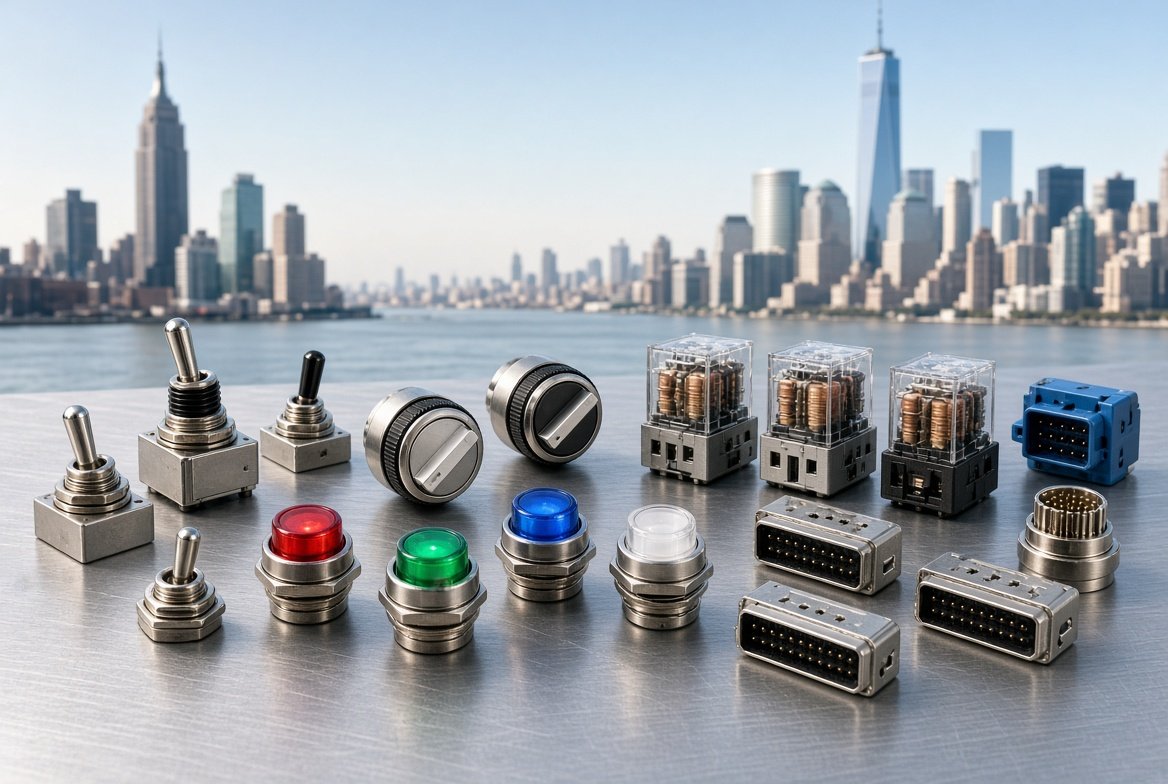
At their core, electromechanical switches rely on physical contacts that open or close when actuated by a lever, button, cam, or other mechanical input. Unlike purely solid-state alternatives, they provide clear tactile or audible feedback, handle higher current loads in many cases, and maintain performance across wide temperature ranges. Common categories include limit switches used to detect position or travel, pushbutton and selector switches for operator control panels, pressure and temperature switches for process monitoring, and snap-action microswitches found in countless machines.
In professional New York settings these components appear in motor control centers, elevator systems, packaging equipment, HVAC controls, and emergency stop circuits. Their mechanical nature means contact materials, actuator design, and sealing against dust or moisture become decisive factors when equipment must operate continuously in demanding environments such as food processing plants or outdoor transit installations.
Key Specifications Professionals Prioritize in New York Markets
Experienced buyers and engineers in the region focus first on electrical ratings. Voltage and current must accommodate both continuous loads and inrush currents that occur when motors or capacitive loads engage. Contact configuration—normally open, normally closed, or changeover—must match the control logic of the system. Mechanical life ratings, often measured in millions of cycles, matter for high-duty applications such as conveyor systems or automated assembly cells.
Electrical life under load is typically lower and depends on the switching current and arc-suppression design. Environmental protection ratings (IP or NEMA classifications) address the realities of New York facilities, where humidity, vibration, wash-down procedures, or temperature swings are common.
Professionals also examine termination styles, mounting options, and actuator types to ensure seamless integration into existing panels or machinery. When a switch must replace an obsolete part, dimensional compatibility and electrical equivalence become additional critical checks that can prevent costly redesigns.
Applications Across New York’s Diverse Industrial Landscape
New York’s industrial base creates varied demand for electromechanical switches. In the greater New York City metropolitan area and surrounding counties, building automation and vertical transportation systems rely on limit switches, interlocks, and emergency-stop devices that meet strict safety codes. Manufacturing and warehouse operations on Long Island and in upstate regions use these switches for machine guarding, position sensing, and process control.
Transportation and infrastructure projects, including rail and port facilities, require robust sealed switches capable of withstanding outdoor exposure. Medical equipment manufacturers and laboratories need high-reliability components with consistent actuation force and long service life. Across these sectors the common thread is the expectation that a switch will perform predictably for years with minimal maintenance, because unplanned downtime in a dense, high-cost operating environment quickly escalates expenses.
Procurement Realities and the Value of Local Expertise
Securing electromechanical switches in New York involves navigating allocation challenges, end-of-life notices from manufacturers, and the need for rapid replacement during unplanned outages. Global supply fluctuations can leave standard catalog items temporarily unavailable, while specialized or legacy designs may require careful cross-referencing.
Professionals therefore benefit from partners who maintain substantial inventory of electromechanical devices alongside semiconductors, passives, and interconnect products, and who can source allocated or obsolete items through established global networks. Local presence matters: the ability to arrange will-call pickup or same-day shipping from facilities in the New York metropolitan region can restore production far faster than distant distribution centers. Technical support that helps match specifications, suggest alternates, or confirm form-fit-function equivalence further reduces risk for engineers and purchasing teams under tight deadlines.
Quality Assurance and Long-Term Reliability Considerations
Quality systems and traceability have become non-negotiable for professional users. Components destined for aerospace, medical, or critical industrial applications often require documentation of origin, date codes, and compliance with relevant standards. Independent distributors that operate under rigorous quality management systems and maintain certified processes help ensure that switches arriving on site meet both electrical performance and documentation expectations.
Inventory management services that hold material on behalf of OEMs or contract manufacturers further protect against future shortages, allowing companies to lock in supply for multi-year production runs or long-life equipment support. In a market where counterfeit parts remain a concern, working with established channels that emphasize authenticity and inspection provides an additional layer of confidence.
Emerging Trends Influencing Switch Selection
While electromechanical designs continue to dominate many applications, professionals increasingly evaluate hybrid solutions that combine traditional contacts with electronic monitoring or that offer improved sealing and materials for extended life. Miniaturization pressures in control panels push demand for compact yet high-current switches. Sustainability considerations encourage selection of devices with longer service intervals and recyclable materials.
At the same time, the persistent need for simple, fail-safe operation keeps pure electromechanical switches relevant wherever solid-state devices might introduce complexity or single-point electronic failure modes. New York professionals therefore balance innovation with proven reliability, often choosing switches that have demonstrated performance in similar regional installations.
FAQs
What makes electromechanical switches preferable for many professional New York applications over solid-state alternatives?
In environments where tactile feedback, high current handling, or immunity to electrical noise is required, electromechanical designs often remain the practical choice. They also tend to be more straightforward to troubleshoot in the field and can operate across broader temperature ranges without additional heat-sinking considerations.
How do professionals typically handle obsolete or allocated electromechanical switches?
The most effective approach combines proactive obsolescence monitoring with relationships that provide access to remaining stock, authorized alternatives, and managed inventory programs that secure material before it becomes scarce.
Are there special considerations for switches used in New York’s outdoor or wash-down environments?
Yes. Sealing ratings, corrosion-resistant materials, and actuator designs that shed water or resist freezing become essential. Professionals routinely specify higher IP or NEMA ratings and confirm that the switch can withstand the cleaning agents or weather extremes common to the installation site.
What documentation should accompany electromechanical switches for critical applications?
Certificates of conformance, material traceability, and any required industry-specific compliance statements help satisfy quality and regulatory requirements. Established distributors can usually supply this documentation as part of standard fulfillment.
How important is local inventory presence for New York professionals?
Extremely important. When a production line or critical system is down, the difference between same-day availability and multi-day shipping can translate into significant cost and schedule impact. Local stocking combined with technical expertise therefore remains a decisive advantage.