Why Food Packaging Matters Beyond Protection
When customers order food for takeaway or delivery, their experience begins before the first bite. The packaging is often the first physical interaction they have with a restaurant after placing an order.
A food container needs to perform a practical job: it should help protect the product during handling, transportation, and delivery. But effective packaging can also contribute to presentation, convenience, and brand recognition.
This creates an important design challenge for restaurants and food businesses. Packaging needs to be functional enough to handle real-world conditions while also presenting the food in a way that feels clean, intentional, and appropriate for the brand.
A well-designed package therefore serves several purposes at once. It protects the food, supports handling, communicates information, and becomes part of the customer’s overall experience.
Protecting Food During Takeaway and Delivery
Food can go through several stages before reaching the customer. It may be prepared in a busy kitchen, packed by staff, moved into a delivery bag, transported by vehicle, and finally carried into the customer’s home.
Packaging needs to account for this journey.The right structure can help reduce movement and provide appropriate support during transportation. Correct sizing is particularly important. A container that is too large may allow unnecessary movement, while packaging that is too small can interfere with the product or make closing difficult.Different foods also have different packaging requirements.
Hot meals may release steam. Fried foods can contain oil and moisture. Delicate products may need additional support to prevent movement or damage. Items with sauces or liquids require packaging that can handle their contents securely.
This means food packaging boxes should be selected according to the actual characteristics of the product rather than simply based on appearance.
Balancing Heat, Moisture, and Presentation
One of the more difficult aspects of food packaging is finding the right balance between retaining heat and managing moisture.A package that traps too much steam can affect the texture of certain foods. At the same time, inadequate protection can allow food to cool too quickly.
The appropriate solution depends on the type of food, expected delivery time, structure of the package, and materials being used.
Presentation matters too.Customers expect delivered food to arrive in a condition that resembles what they would receive at the restaurant. Packaging that helps maintain the position and appearance of the food can contribute to that expectation.
Good packaging does not need to eliminate every challenge associated with food delivery. Instead, it should be designed around the specific conditions the product is likely to encounter.
Choosing Packaging Around the Product
There is no universal food package that works equally well for every business.
A burger restaurant may need different packaging from a bakery. A pizza business has different requirements from a café selling sandwiches or a restaurant delivering full meals.
Product dimensions, weight, temperature, moisture, serving style, and transportation conditions should all influence the packaging decision.This is where customization can become particularly useful.
Rather than forcing different products into the same generic format, businesses can choose packaging that better matches their products and operational requirements.
How Food Packaging Becomes Part of a Brand
A restaurant’s brand does not exist only on its website, menu, storefront, or social media pages.
It also exists in the physical objects customers interact with.
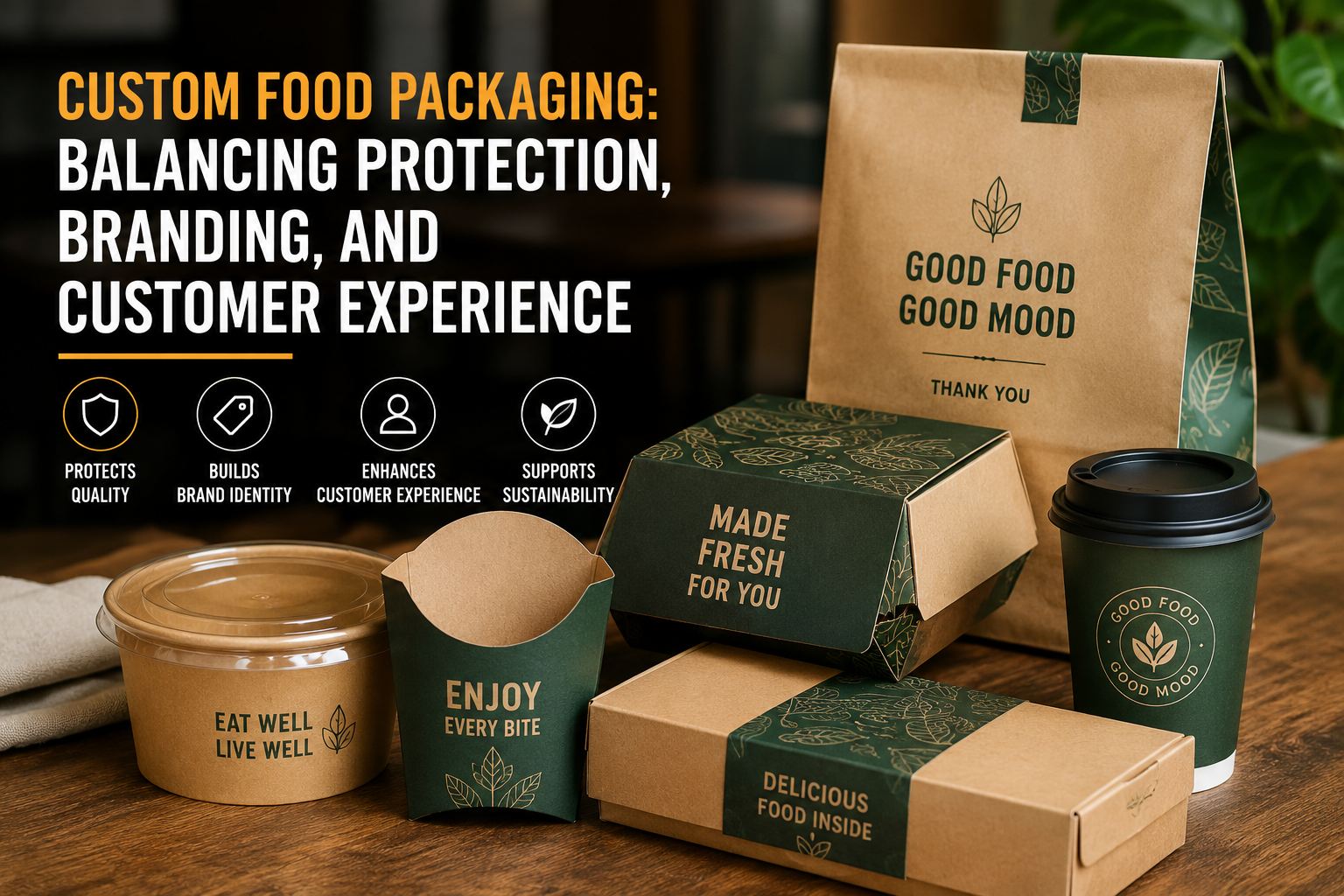
Food packaging can therefore become an extension of a restaurant’s visual identity. Colors, typography, illustrations, patterns, and logo placement can help create consistency between the physical order and the rest of the brand.
The goal is not to cover every available surface with branding.
A more effective approach is often to establish a recognizable visual system and apply it consistently.
For example, a restaurant might use a distinctive color combination across its boxes, bags, labels, and menus. Another business might rely on a particular illustration style or typography system.
When these elements work together, packaging becomes easier to associate with the restaurant.
The Role of Custom Food Packaging in Brand Recognition
Generic packaging can perform its basic function, but it provides fewer opportunities for a business to communicate its personality.
Custom food packaging allows restaurants and food brands to make packaging part of their visual identity while still keeping the practical requirements of food protection in mind.
A thoughtfully designed package can communicate whether a brand is modern, traditional, playful, premium, minimalist, or focused on sustainability.
The important thing is alignment.
Packaging should feel like it belongs to the brand rather than looking like a separate design created without consideration for the rest of the customer experience.
Designing Packaging That Works on the Shelf and in Delivery
Food packaging may be encountered in several different environments.
A customer might see it on a restaurant counter, inside a takeaway bag, on a dining table, or after a delivery arrives at home.
Each situation presents a slightly different design challenge.
The exterior should communicate the brand clearly without making important information difficult to find. The package should also be practical to handle and store.
For delivery-focused businesses, structural considerations become especially important. Packaging may need to withstand stacking and movement while maintaining a professional appearance.
This is why visual design and structural design should not be treated as completely separate processes.
A beautiful package that does not perform well can create a disappointing experience. Conversely, a highly functional package with no connection to the brand may miss an opportunity to build recognition.
The strongest solutions bring the two together.
Creating a Better Takeaway and Unboxing Experience
Opening a food order is a simple interaction, but it can still influence how customers perceive the business.
A package that opens easily, keeps different components organized, and presents the food neatly can make the experience feel more considered.
Small details can make a difference.
A clean interior, an appropriate closure, well-positioned compartments, or a simple branded message can reinforce the restaurant’s identity without adding unnecessary complexity.
However, memorable packaging does not mean complicated packaging.
If customers have to struggle with excessive layers or difficult closures, the design can become an inconvenience rather than an improvement.
The best customer experience is often one where functionality feels almost effortless.
Sustainability, Practical Design & Future Trends
Sustainable Considerations in Food Packaging
Sustainability has become an increasingly important consideration for food businesses, but responsible packaging requires more than simply choosing a material marketed as environmentally friendly.
The entire packaging system should be considered.
Businesses can ask:
- Is the package appropriately sized?
- Is unnecessary material being used?
- Can the structure be simplified?
- Are additional components genuinely necessary?
- How will the packaging be handled after use?
- Does the material choice make sense for the product’s requirements?
These questions can lead to more thoughtful packaging decisions.
Material efficiency is particularly important. A package should provide appropriate protection without automatically using more material than the product requires.
At the same time, sustainability should not come at the expense of food safety or functionality.
If a package cannot adequately protect the food, it has failed at one of its most important jobs.
Sustainability Without Losing Brand Identity
Responsible packaging does not have to look plain.
Brand personality can still be expressed through typography, color, illustration, structure, and layout.
In some cases, simplifying the material or removing unnecessary decorative elements can actually make a package feel more refined.
The important principle is authenticity.
Sustainability should be supported by genuine design and material decisions rather than treated as a marketing label.
Seven Principles for Better Food Packaging
1. Start With the Food
Understand the product’s size, weight, temperature, moisture, and handling requirements before choosing the package.
2. Prioritize Protection
The package should be capable of supporting the food throughout preparation, transportation, and delivery.
3. Choose Appropriate Dimensions
A good fit can improve presentation and reduce unnecessary movement.
4. Keep Branding Consistent
Use visual elements that connect packaging with the wider restaurant identity.
5. Design for Convenience
Packaging should be easy for staff to pack and customers to open, carry, and handle.
6. Avoid Unnecessary Complexity
Every additional feature should have a practical or experiential purpose.
7. Consider the Package’s Entire Lifecycle
Think about material use, production, transportation, customer use, and disposal rather than evaluating the package at only one stage.
The Future of Food Packaging
Food packaging is likely to become increasingly integrated with the broader customer experience.
Restaurants are no longer competing only through the food itself. They are also building identities across physical locations, websites, social platforms, delivery services, and takeaway experiences.
Packaging boxes connects several of these touch points.A recognizable box can reinforce a brand when an order arrives at someone’s home. A well-designed container can communicate professionalism before the food is tasted. A thoughtful structural solution can improve convenience while reducing unnecessary material.
Future packaging innovation does not necessarily need to involve complicated technology.
It can come from relatively simple improvements:
- Better product fit
- More efficient structures
- Improved ventilation
- Clearer visual hierarchy
- More practical opening mechanisms
- Better material utilization
- Stronger brand consistency
The most useful innovation is often the kind that solves an actual problem.
From Food Container to Brand Experience
Food packaging has traditionally been viewed as a practical necessity.
But for modern restaurants and food businesses, it can play a much broader role.
It protects the product, supports transportation, communicates brand identity, influences presentation, and contributes to the customer’s experience after the order leaves the kitchen.
That makes packaging a unique combination of function, design, and communication. When these elements are considered together, a simple food container can become a meaningful part of the brand.
Conclusion
Effective food packaging starts with the product but does not end there.The right package needs to protect food during its journey while remaining practical for staff and convenient for customers. At the same time, thoughtful design can turn packaging into an extension of the restaurant’s identity.The strongest solutions do not choose between functionality and visual appeal.They balance both.By considering product requirements, structural performance, branding, customer experience, and material efficiency from the beginning, food businesses can create packaging that performs its practical role while leaving a stronger impression.Ultimately, the best food packaging is not simply the package that holds the meal.