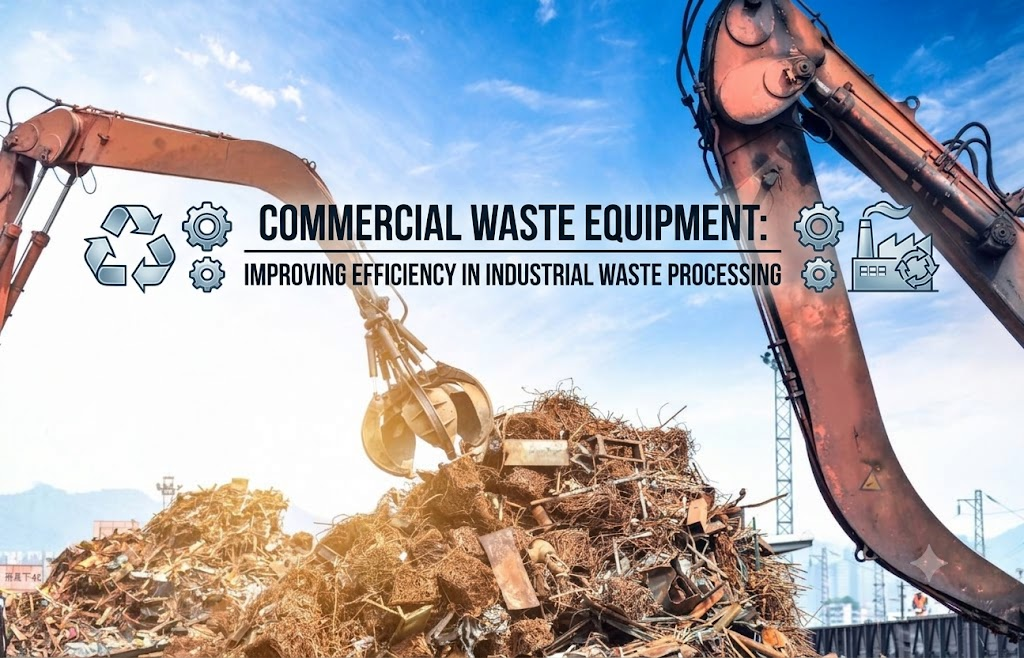
Commercial and industrial facilities generate diverse waste streams, including cardboard, plastics, metals, timber, packaging, and organic materials. Managing these materials efficiently requires more than collection bins and scheduled disposal. Businesses need suitable systems to move, separate, process, and recover waste while maintaining safe and organised operations. Commercial waste equipment helps facilities handle these tasks more systematically, supporting material recovery and reducing the volume of waste sent to landfill where practical. Understanding how different machines work together allows operators to plan a system around their waste volumes, available space, processing targets, and long-term operational requirements.
Why Equipment Selection Matters in Waste Management
Waste streams vary considerably between industries. A warehouse may produce large quantities of cardboard and plastic packaging, while a construction facility may handle timber, metal, concrete, and mixed demolition materials. Food-processing operations may also need systems designed for organic waste with different moisture and handling characteristics.
Using equipment that matches the incoming materials helps maintain a consistent workflow. Poorly matched machinery can create bottlenecks, increase manual handling, and make downstream sorting less effective. Before investing in new equipment, operators should assess waste composition, daily throughput, contamination levels, available floor space, and the quality requirements of recovered materials.
This assessment helps establish whether a facility needs individual machines, an integrated processing line, or upgrades to an existing plant.
Essential Equipment for Commercial Waste Processing
Conveyors and Feeding Systems
Conveyors move materials between processing stages, reducing the need to transport waste manually. Feeding equipment, including bag openers and specialised loading systems, helps introduce material into a line at a controlled rate. Consistent feeding can support smoother operation and prevent downstream machinery from receiving uneven loads.
Shredders and Size-Reduction Machines
Shredders reduce bulky materials into smaller, more manageable pieces. Depending on the design and application, they may process plastics, timber, tyres, and other suitable waste streams. Hammermills and grinding systems provide further size reduction where a particular particle size is required for separation or subsequent processing.
Equipment selection should account for material strength, moisture, potential contaminants, and the required output size.
Screening and Separation Systems
Screens separate materials according to size, while ballistic separators can distinguish flat materials, such as paper and film, from more rigid three-dimensional objects. Magnetic separators recover ferrous metals, and eddy-current systems can separate suitable non-ferrous metals such as aluminium. Optical sorting technology can identify selected materials using sensors.
Balers and Compactors
Balers compress recyclable materials into dense packages that are easier to store and transport. Compactors reduce waste volume for handling and transfer, depending on the system and material involved. These machines can help facilities manage limited storage space and organise outbound material movements more efficiently.
How Integrated Systems Improve Workflow
Individual machines perform specific tasks, but their effectiveness also depends on how they connect. A processing line might feed mixed waste onto conveyors, separate materials by size, recover metals, and then use optical sorting to distinguish selected recyclable materials. The exact sequence depends on the waste stream and the required outputs.
Well-planned waste equipment solutions consider material flow from the point of arrival through to final recovery or disposal. Equipment placement, access for maintenance, control systems, and safety guarding all influence how effectively a facility operates.
Automation may further support consistency by coordinating machinery and monitoring operating conditions. However, automated systems still require appropriate configuration, trained personnel, routine inspections, and maintenance procedures.
Considerations Before Investing in Waste Equipment
Choosing suitable waste management equipment starts with measurable operational requirements rather than machine specifications alone. Estimate daily and peak throughput, identify the materials that need processing, and define the quality standards expected by downstream recyclers or end users.
Assess the site’s power supply, available footprint, access routes, maintenance requirements, and staffing capabilities. Consider the full project cost, including installation, commissioning, consumables, servicing, and potential production interruptions during implementation.
Conclusion
Effective waste processing depends on matching equipment to material types, throughput requirements, site conditions, and recovery goals. For businesses exploring tailored industrial processing systems and integrated recycling technologies, OGTEC provides a starting point for learning about equipment design, manufacturing, installation, and plant integration. A carefully designed system can improve material handling, support recycling, and help facilities manage waste more consistently.