A packaging line that performs well today may struggle to meet production demands six months later. As order volumes grow, businesses often face longer packaging cycles, increased manual handling, and greater pressure to maintain consistent product quality. Adding more employees or extending working hours may provide temporary relief, but these approaches do not always address the underlying limitations.
An automatic shrink packaging machine can be worth considering when packaging becomes a measurable production bottleneck. However, automation is not automatically the best choice for every operation. Product variety, daily output, equipment compatibility, and operational costs all influence whether investing in automated machinery makes financial and practical sense.
Rather than focusing only on packaging speed, businesses should evaluate how automation changes the entire production workflow.
The Turning Point: When Manual Packaging Becomes a Bottleneck
Small packaging operations frequently begin with manual or semi-automatic equipment.
These systems can be appropriate when order volumes are manageable, product dimensions vary frequently, or production runs are relatively short.
Problems may develop as output increases.
Operators might spend substantial time positioning products, adjusting film, and transferring packages between machines. Repeated manual actions can also create variations in finished package quality.
Signs that packaging operations may be approaching their limits include:
- Finished products accumulating before the packaging station.
- Frequent overtime required to complete packaging.
- Increased demand for repetitive manual handling.
- Difficulty maintaining consistent packaging output.
- Production delays during high-volume periods.
- Limited capacity to accommodate additional orders.
These issues do not always justify immediate equipment replacement. However, they indicate that businesses should begin evaluating their production capacity and process efficiency.
What Actually Changes With an Automatic System?
An automatic shrink packaging machine performs selected packaging operations through coordinated mechanical and electronic systems.
Depending on the configuration, automated functions may include product feeding, film positioning, sealing, trimming, and package transfer.
In a typical shrink wrapping line, the sealing equipment prepares the film around the product before the package proceeds through a shrink tunnel.
Automatic L-bar sealers are one option for products suitable for center-folded film applications.
Modern systems may incorporate sensors, programmable controls, servo motors, and adjustable conveyors to maintain more consistent operating conditions.
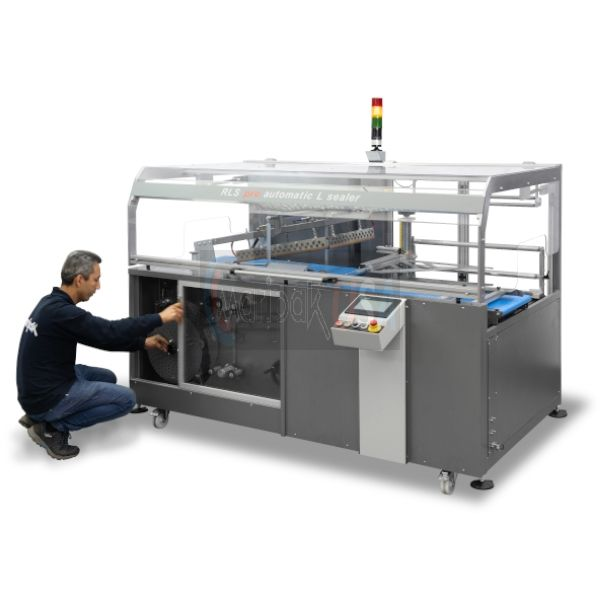
For example, the RLS ePRO series of automatic L-sealers includes servo-driven operation, sensor-based length detection, touchscreen controls, and film tension management features.
These functions illustrate how automation can reduce certain repetitive adjustments, although actual performance depends on product characteristics and machine setup.
Three Production Situations Worth Evaluating
The suitability of automation becomes clearer when viewed through real operating scenarios.
Scenario A: A Business Packaging Identical Products Daily
Consider a manufacturer that packages hundreds of similar boxed products during each shift.
Because the products have consistent dimensions, machine settings may require relatively few adjustments.
In this situation, automatic equipment may offer advantages through repeatable sealing operations and reduced manual handling between packages.
The potential benefit depends on the actual production volume and how much time is currently spent on repetitive activities.
Scenario B: A Company With Frequent Product Changes
A business packaging several different product sizes throughout the day faces different challenges.
Automatic machinery may improve processing consistency, but frequent changeovers can reduce the expected productivity gains.
Features such as saved product settings, adjustable sealing dimensions, and automated length detection may make transitions more manageable.
However, the business should evaluate how long each changeover takes and whether the equipment accommodates its full product range.
Scenario C: A Growing E-commerce Fulfillment Operation
An e-commerce operation may experience significant order fluctuations during promotional campaigns and seasonal shopping periods.
An automatic shrink packaging machine may help maintain a predictable wrapping process during busy periods.
Nevertheless, the machine’s capacity should be compared with available upstream product feeding and downstream packing resources.
Increasing sealing speed will not solve a bottleneck elsewhere in the fulfillment process.
The Numbers That Matter Before Investing
A useful automation decision requires measurable operating data.
| Performance indicator | Why it matters |
| Packages completed per hour | Establishes existing production capacity |
| Labor hours per production run | Helps evaluate repetitive handling requirements |
| Film consumption | Identifies material efficiency opportunities |
| Rejected packages | Reveals packaging quality and rework costs |
| Equipment downtime | Measures reliability and lost production time |
| Product changeover duration | Shows the impact of packaging different sizes |
| Maintenance expenses | Supports long-term operating cost estimates |
Businesses should collect these measurements during normal production rather than relying on a single unusually busy or quiet day.
For example, if packaging output changes significantly depending on which operator is assigned, additional training or better procedures may improve performance even before new machinery is installed.
Reliable baseline data makes it easier to determine whether automation offers a meaningful improvement.
How Much Automation Is Enough?
One of the most important decisions is determining which packaging activities actually need to be automated.
Not every business requires a fully integrated production line.
A company may benefit from automatic sealing while retaining manual product loading for unusual items.
Another operation might need synchronized conveyors, automatic product feeding, and automated discharge handling to meet its production requirements.
The goal is to identify the appropriate level of automation rather than introducing unnecessary complexity.
Compare Equipment Capabilities
| Consideration | Semi-automatic equipment | Fully automatic equipment |
| Operator involvement | Usually required for selected steps | Lower during regular processing |
| Production consistency | Depends partly on operator actions | More machine-controlled operations |
| Initial equipment investment | Generally lower | Generally higher |
| Integration requirements | Often simpler | May require additional planning |
| Suitability | Moderate production or variable work | Repetitive, sustained production requirements |
Actual differences depend on the specific machine, product, and operating environment.
An automatic system may be more productive during continuous runs but provide limited advantages when products require frequent manual preparation.
Why Product Dimensions Should Drive the Decision
A common purchasing mistake is evaluating production speed before confirming dimensional compatibility.
Every packaging machine has limits involving product width, height, length, and sealing area.
A product that exceeds these limits may not be suitable for the equipment, regardless of its advertised operating speed.
For instance, the RLS ePRO automatic L-sealer range includes different model sizes. Manufacturer specifications list a 23-by-17-inch sealing area for model 5844 and a 32-by-24-inch sealing area for model 8065.
These dimensions help demonstrate why equipment should be selected according to actual packaging requirements rather than model category alone.
Businesses should also confirm compatible film types, approved thickness ranges, and appropriate product transfer arrangements.
An automatic shrink packaging machine should accommodate both current products and reasonably anticipated packaging requirements without compromising safe operation.
Hidden Costs That Deserve Attention
Equipment purchase price is only one part of an automation investment.
Installation, employee training, maintenance, spare parts, and production line modifications can all affect the overall cost.
Businesses may also need to consider additional electrical requirements, conveyor integration, safety systems, and available floor space.
If packaging equipment requires specialized technical support, the availability of replacement components becomes particularly important.
Before making a decision, obtain clear information about:
- Installation and commissioning responsibilities.
- Operator and maintenance training.
- Warranty coverage and exclusions.
- Recommended spare parts.
- Routine maintenance requirements.
- Technical support availability.
- Compatibility with existing machinery.
These details provide a more complete understanding of long-term ownership responsibilities.
A Practical Readiness Check
Before investing in automation, ask whether the packaging operation can answer the following questions confidently.
Is there a documented capacity problem?
If existing equipment consistently meets production requirements, an upgrade may not be urgent.
Are product specifications sufficiently predictable?
Automatic machinery generally benefits from clear dimensional and handling requirements.
Can upstream and downstream processes support increased output?
Packaging improvements should not simply move the bottleneck elsewhere.
Have the operating costs been calculated?
Savings should be evaluated alongside maintenance, training, and equipment investment.
Can the selected machine be tested with representative products?
A practical demonstration can reveal handling or sealing limitations that are not obvious from specifications.
If several of these questions remain unanswered, further evaluation may be more valuable than immediately purchasing equipment.
Conclusion: Let Production Requirements Guide the Investment
The right time to automate is when production evidence supports the change. Businesses that understand their packaging volumes, labor requirements, quality problems, and equipment limitations are better positioned to select machinery that addresses genuine operational needs. For companies exploring a machine for shrink wrapping, the most useful comparison is often between the performance of the existing process and the realistic capabilities of a proposed system, rather than between advertised maximum speeds. An automatic shrink packaging machine should make packaging operations more predictable and manageable without creating unnecessary complexity. When the decision is supported by production data, product testing, and a clear understanding of long-term costs, automation becomes a carefully planned operational improvement rather than simply another equipment purchase.