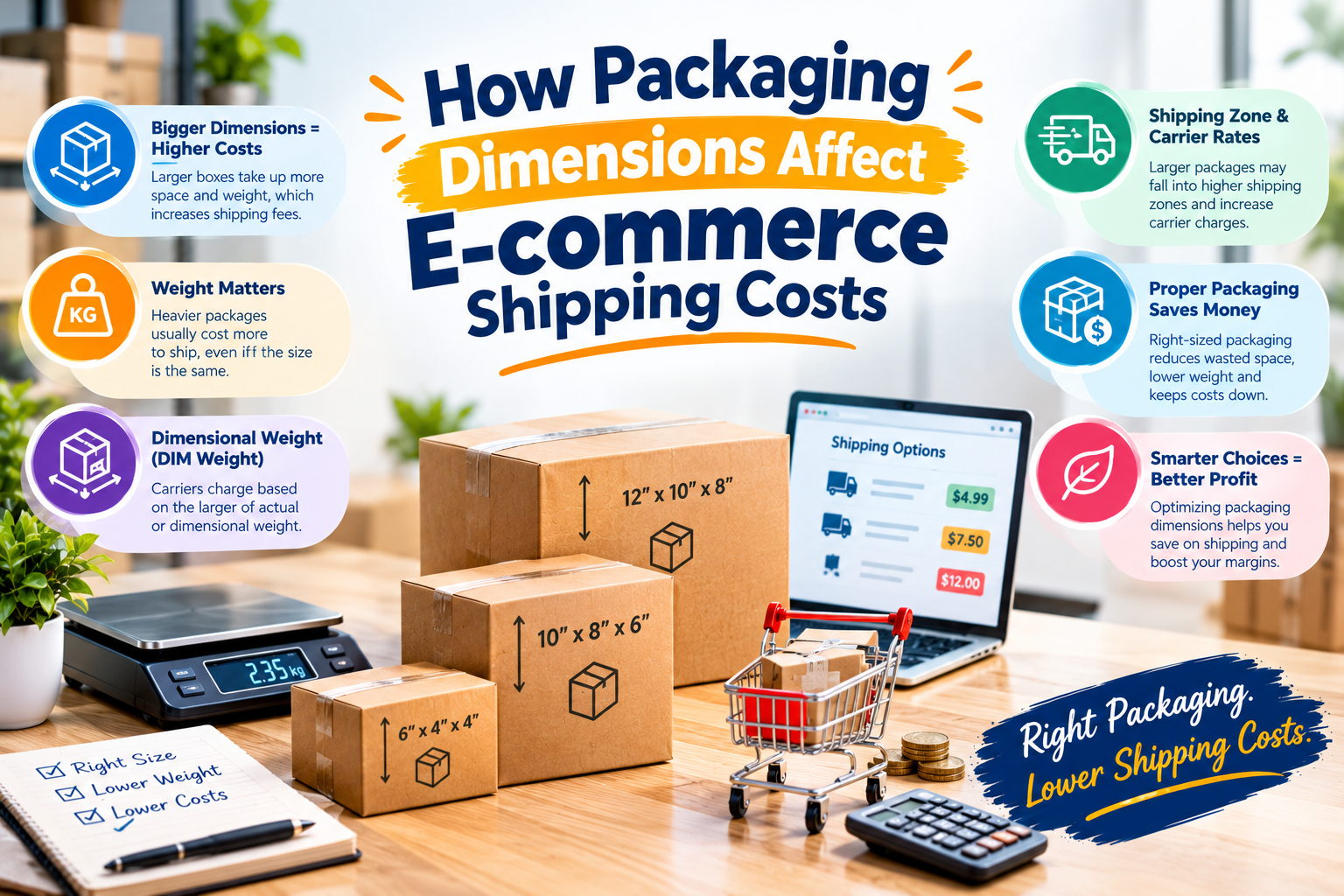
For an e-commerce business, shipping expenses can quietly reduce profit margins. Business owners often compare courier rates, negotiate delivery contracts, and look for affordable shipping options. However, one important factor can easily be overlooked: the size of the packaging used for each order.
A product may be relatively light, yet it can cost more to ship if it occupies unnecessary space. This is why businesses need to consider Custom Mailer Boxes when choosing packaging for suitable products. A well-fitted box can help reduce unused space while keeping the product secure, although actual savings depend on the carrier’s pricing rules and the packaging requirements.
Choosing suitable packaging dimensions helps businesses use space more efficiently, reduce unnecessary material consumption, and manage fulfilment costs. For online retailers handling dozens or hundreds of orders, these small improvements can make a meaningful difference over time.
Why Packaging Size Matters in E-commerce
Packaging does more than protect products during transportation. Its dimensions also influence how efficiently parcels fit into delivery vehicles, storage areas, and sorting facilities.
When a box is larger than necessary, it takes up more space throughout the delivery process. Couriers may therefore charge more for a parcel that occupies substantial space relative to its weight.
Consider a business shipping lightweight accessories. If each item is packed in a large carton with excessive empty space, the company may pay for transporting unused volume. Across hundreds of monthly orders, these additional charges can become a recurring business expense.
The challenge is to find a balance between compact packaging and adequate product protection. Reducing box size is useful only when the product remains secure throughout transportation.
Understanding Dimensional Weight and Shipping Charges
Dimensional weight, sometimes called volumetric weight, is a pricing method used by many shipping carriers. It estimates how much space a parcel occupies rather than considering only its physical weight.
The calculation generally uses the parcel’s length, width, and height, together with a carrier-specific divisor.
For example, a carrier may calculate dimensional weight using this formula:
Dimensional weight = Length × Width × Height ÷ Dimensional divisor
The measurements and divisor depend on the carrier, service, and applicable units. Some carriers use inches and pounds, while others use centimetres and kilograms.
In many shipping arrangements, the billable weight is based on whichever is greater: the actual weight or the dimensional weight. Additional rules, minimum charges, and rounding practices may also apply.
This means businesses should check their carrier’s pricing rules rather than assume every parcel will be charged according to its physical weight alone.
How Oversized Packaging Increases Business Expenses
Using unnecessarily large boxes can affect costs in several ways. The impact is not always limited to the courier invoice.
Higher Shipping Charges
Larger parcels can have a higher dimensional weight, potentially increasing the billable weight. Businesses shipping lightweight products should pay particular attention to the relationship between package volume and actual product weight.
Greater Material Consumption
Oversized cartons often require more cardboard, tape, and protective filling. These materials increase the cost of preparing each order and may create additional waste.
Less Efficient Warehouse Storage
Large packaging takes up more room on shelves and in packing areas. It can also make it harder for staff to organise supplies and maintain an efficient fulfilment process.
More Complicated Order Handling
Excessive packaging may require additional filling, more handling time, and larger storage spaces. If the packing process is repeated across many daily orders, small inefficiencies can accumulate.
Businesses can address these issues by reviewing their most frequently shipped products and identifying where packaging dimensions exceed practical requirements.
Choosing the Right Box Size for Each Product
The most effective packaging size depends on the product’s shape, weight, fragility, and shipping requirements. A compact box is not automatically the best choice if it leaves insufficient room for protective materials.
Businesses should consider the following factors when selecting packaging:
- Product dimensions: Measure the product carefully and allow enough room for any necessary protective inserts.
- Fragility: Glass, ceramics, and sensitive electronics may require additional cushioning around vulnerable areas.
- Shipping method: Check carrier limits, dimensional-weight rules, and any restrictions on parcel size.
- Packing efficiency: Choose box sizes that are easy to assemble, fill, seal, and store.
- Order combinations: If customers frequently purchase several items together, consider whether a suitable combined package can reduce unnecessary space.
A practical approach is to group products by size and packaging requirements. This helps businesses avoid using a different box for every order while still providing a suitable fit.
How Custom Packaging Can Improve Shipping Efficiency
Standard boxes may work well for some products, but businesses with varied product dimensions can struggle to find suitable sizes. A box that fits one item may be unnecessarily large for another.
Packaging designed around product dimensions can help businesses reduce unused space while maintaining the room needed for cushioning and secure packing. However, the benefits depend on selecting the right dimensions rather than simply making every box smaller.
The goal is to create a practical fit that balances product protection, material use, and shipping requirements.
Before changing packaging specifications, businesses should compare the cost of different box sizes, assess product damage rates, and check how the proposed dimensions affect courier charges. This helps ensure that a reduction in packaging size produces genuine savings rather than creating new problems.
When Mailer Boxes Make More Sense
Mailer boxes can be useful for e-commerce businesses shipping products that fit securely within a compact, self-closing package. They are commonly used for apparel, accessories, subscription products, and selected retail items.
Their structure can simplify packing, while suitable sizing can help reduce unnecessary space around the contents. However, mailer boxes are not suitable for every product. Heavy items, unusually shaped products, or fragile goods may need a different carton design or additional protective packaging.
Businesses should evaluate the product’s weight, dimensions, and handling requirements before selecting a mailer box. Testing a proposed package with the actual product can help identify problems before the design is used for regular shipments.
Practical Ways to Reduce Packaging-Related Shipping Costs
Businesses do not necessarily need a complete packaging redesign to improve efficiency. A few targeted changes can help identify and address avoidable expenses.
- Audit existing box sizes: Review which cartons are used most often and identify products that consistently leave excessive empty space.
- Measure parcels after packing: Record the final external dimensions, since courier charges are generally based on the shipped parcel rather than just the product.
- Review carrier pricing rules: Check dimensional divisors, size limits, rounding policies, and additional handling fees.
- Standardise suitable sizes: Maintain a manageable selection of cartons for common product groups.
- Train packing staff: Provide clear instructions on selecting boxes and placing protective materials correctly.
- Monitor damage and returns: Confirm that smaller packaging does not increase breakage, customer complaints, or replacement shipments.
- Compare total costs: Consider box prices, labour, shipping charges, and damage-related expenses together instead of focusing on one cost alone.
These steps allow businesses to make packaging decisions using actual operational information rather than assumptions.
Measuring Whether Packaging Changes Are Working
A packaging adjustment should be evaluated against clear business measures. Lower material use does not necessarily mean lower overall costs if shipping charges remain unchanged or product damage increases.
Businesses can track several indicators to assess performance:
- Average shipping cost per order
- Packaging cost per shipment
- Percentage of parcels using oversized cartons
- Product damage and return rates
- Time required to pack each order
- Amount of unused packaging material
Comparing these figures before and after a change can reveal whether the new packaging approach is delivering measurable improvements.
It is also useful to review results across different product categories. A compact box may work well for clothing but provide insufficient protection for ceramic items. Packaging decisions should reflect these differences rather than follow a single rule for every order.
Conclusion
Packaging dimensions play an important role in e-commerce shipping costs. Oversized cartons can increase dimensional weight, consume additional materials, and make storage and order fulfillment less efficient. At the same time, packaging that is too small can compromise product protection and increase the risk of costly returns.
Businesses can improve efficiency by measuring products accurately, reviewing carrier pricing rules, and choosing packaging that fits each product’s requirements. Evaluating options such as Custom Packaging Boxes can help businesses explore suitable sizes and packaging styles while balancing protection, material use, and shipping expenses.
By treating packaging dimensions as part of shipping and fulfilment planning, e-commerce businesses can make better cost decisions and build a more efficient delivery process.
Frequently Asked Questions
1. How do packaging dimensions affect e-commerce shipping costs?
Packaging dimensions can affect dimensional weight, which some carriers use to calculate shipping charges. Larger parcels may cost more to ship even when their actual weight is low.
2. What is dimensional weight in shipping?
Dimensional weight is a calculated weight based on a parcel’s length, width, and height. Carriers may use it alongside actual weight to determine the billable weight.
3. Can smaller boxes reduce shipping expenses?
Yes, when the smaller box reduces billable dimensions without compromising product protection. Businesses should also consider material costs, packing time, and potential damage.
4. Are custom-sized boxes suitable for every e-commerce business?
Not necessarily. They may benefit businesses with recurring product sizes or high shipping volumes, while standard cartons may be more practical for businesses shipping varied or irregular products.
5. How can businesses choose the right packaging dimensions?
They should measure products, account for protective cushioning, review carrier requirements, and test the finished package before using it for regular shipments.
6. Do mailer boxes help reduce packaging costs?
They can help when their dimensions suit the product and their structure reduces unnecessary space or packing time. Their suitability depends on the product’s weight, shape, and protection requirements.
7. How often should businesses review their packaging sizes?
Businesses should review packaging when product ranges change, shipping costs rise, damage reports increase, or order volumes reveal recurring inefficiencies. Regular reviews can help identify savings opportunities.