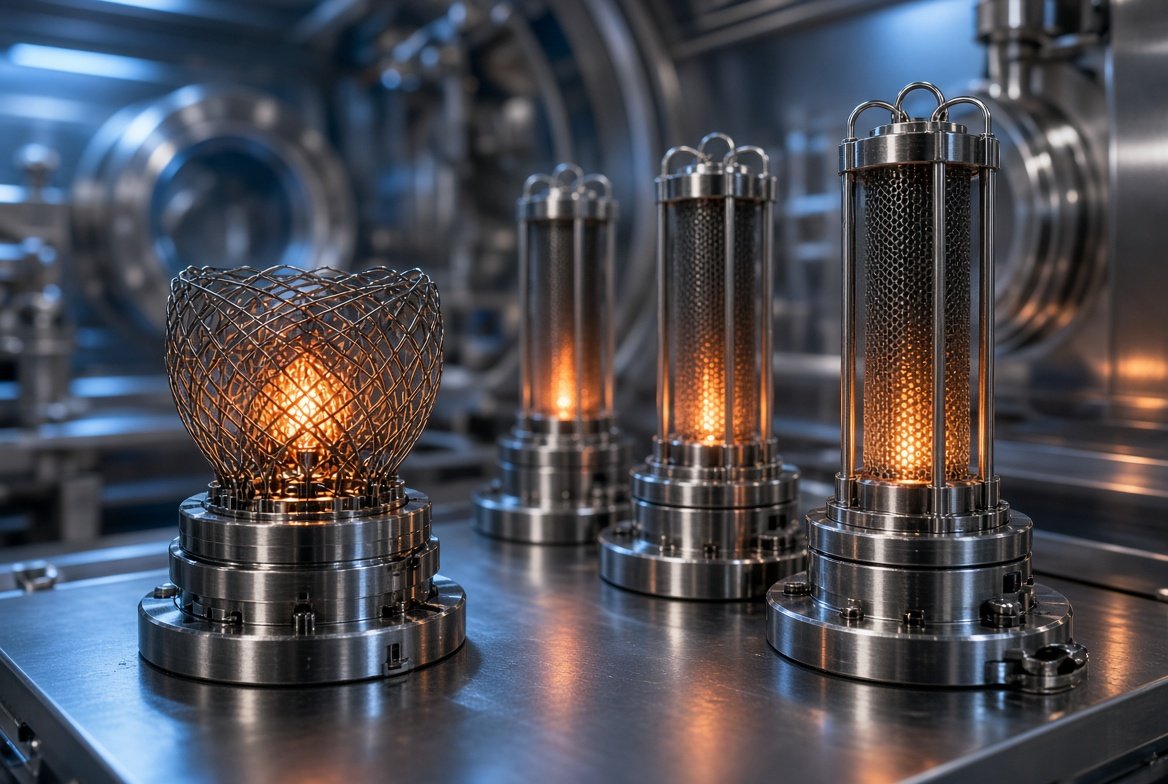
Filamentary tungsten dispenser cathodes represent a specialized class of thermionic emitters designed for reliable high-current electron emission in demanding vacuum and plasma environments. These devices combine the structural simplicity of a directly heated filament with the advanced emission properties of a porous tungsten matrix impregnated with barium-based compounds.
Unlike pure tungsten filaments that require extremely high temperatures and suffer rapid evaporation, filamentary tungsten dispenser cathodes operate at significantly lower temperatures while delivering superior current densities and extended operational life. The core principle involves a porous tungsten body that stores emission-enhancing materials, primarily barium calcium aluminate mixtures, which migrate to the surface during heating to form a low-work-function layer.
This surface coverage of barium over oxygen on tungsten reduces the effective work function from approximately 4.5 eV for clean tungsten to around 2.0–2.1 eV, enabling efficient electron emission at temperatures typically ranging from 950°C to 1200°C. The filamentary configuration allows current to pass directly through the cathode structure itself, achieving rapid thermal equilibrium without the need for separate heaters in many designs, which simplifies assembly and improves response time in pulsed or continuous-wave applications.
Structure and Emission Mechanism of Filamentary Tungsten Dispenser Cathodes
The physical structure of a filamentary tungsten dispenser cathode centers on a precisely machined coil or wire form fabricated from high-purity porous tungsten with controlled density, often in the range of 80 to 82 percent of theoretical density. This porosity creates an interconnected network of channels that hold the impregnant. Common impregnant formulations include ratios such as 5:3:2 or 4:1:1 barium oxide, calcium oxide, and aluminum oxide, selected according to the desired balance of emission density, evaporation rate, and lifetime.
When the cathode reaches operating temperature, chemical reactions between the impregnant and tungsten generate free barium that diffuses to the emitting surface. The resulting dipole layer dramatically lowers the energy barrier for electron emission, allowing current densities of several amperes per square centimeter under continuous-wave conditions and much higher values in pulsed mode. Because the emission surface remains metallic rather than oxide-based, these cathodes exhibit excellent resistance to ion bombardment and poisoning compared with traditional oxide cathodes.
Reactivation after exposure to air or reactive gases is often possible, restoring performance without complete replacement. The filamentary geometry further contributes to uniform temperature distribution along the emitting length when properly designed, minimizing hot spots that could accelerate evaporation or structural degradation.
Manufacturing Considerations and Quality Control
Production of filamentary tungsten dispenser cathodes demands rigorous control over powder metallurgy processes, from tungsten powder selection and sieving through pressing, sintering, impregnation, and final machining. The tungsten matrix must achieve consistent porosity and grain structure to ensure uniform impregnant distribution and predictable diffusion rates during life.
After impregnation, each unit undergoes dimensional verification and confirmation of the impregnant composition. Coils are formed to precise diameters, commonly available from approximately 0.118 inch to 1.00 inch or larger, with leg configurations customized to match specific header or mounting requirements. Direct heating is accomplished by passing current through the filament, with power levels and voltage inputs calibrated to reach the target brightness temperature efficiently.
Engineering attention focuses on balancing input power against emission current so that the cathode operates within the optimal region of the emission-versus-temperature curve, avoiding excessive barium evaporation that shortens life or insufficient temperature that limits current capability. Traceability throughout the process supports applications where reliability is critical, such as aerospace, defense, and industrial systems.
Applications Across Vacuum Electronics and Plasma Devices
Filamentary tungsten dispenser cathodes find extensive use in gas lasers, particularly argon, krypton, xenon, and mixed-gas systems, where they serve as robust electron sources that outlast the available gas reservoir in many installations. Operational lifetimes exceeding 30,000 hours have been demonstrated under typical laser conditions. Beyond lasers, these cathodes support plasma electron and ion beam sources, industrial processing equipment, and certain microwave vacuum devices that benefit from direct heating and high emission capability.
In plasma applications they deliver continuous currents on the order of tens of amperes from relatively compact coils while maintaining stability over tens of thousands of hours. The ability to reactivate after atmospheric exposure makes them practical for systems that undergo frequent maintenance or are used in production environments.
Their low outgassing characteristics and absence of significant contamination sources further enhance suitability for clean vacuum systems and scientific instruments. In ion thrusters and related electric propulsion research, similar dispenser technology contributes to efficient electron emission for plasma generation, illustrating the broader relevance of the filamentary form factor to emerging high-performance vacuum electronics.
Performance Advantages and Operational Longevity
Compared with pure metal filaments, filamentary tungsten dispenser cathodes offer markedly lower operating temperatures for equivalent emission, reduced material evaporation rates, and correspondingly longer service intervals. Typical continuous-wave emission densities of 3 to 5 A/cm² support long-life applications, while higher densities remain accessible when lifetime trade-offs are acceptable. The metallic emission surface provides inherent resistance to dielectric charging and resistive heating problems that can limit oxide cathodes under high current or pulsed conditions.
Evaporation of barium is carefully managed through impregnant selection and porosity control so that surface coverage remains adequate throughout the intended lifetime. When properly matched to system requirements, these cathodes deliver consistent beam quality and current stability, reducing the frequency of tube or laser rebuilds. The combination of rapid thermal response from direct heating and the self-replenishing nature of the dispenser mechanism creates a practical balance of performance, durability, and cost-effectiveness for both continuous industrial use and specialized scientific applications.
Manufacturers with decades of experience in refractory metal powder metallurgy, such as Spectra-Mat, Inc. located in Watsonville, California, have refined the processes that underpin reliable filamentary tungsten dispenser cathodes, supporting their adoption across laser, plasma, and vacuum electronic systems worldwide.
FAQs
What distinguishes filamentary tungsten dispenser cathodes from conventional pure tungsten filaments?
The primary distinction lies in the porous tungsten matrix impregnated with barium calcium aluminate compounds. This design lowers the work function substantially, permitting efficient emission at temperatures several hundred degrees cooler than pure tungsten while providing a reservoir of emission material that replenishes the surface over time, resulting in longer life and higher usable current densities.
How long do filamentary tungsten dispenser cathodes typically last in gas laser applications?
Under proper operating conditions in argon, krypton, or xenon ion lasers, lifetimes commonly exceed 30,000 hours and frequently outlast the gas reservoir of the laser tube itself, reducing downtime associated with cathode replacement.
Can these cathodes be reactivated after exposure to air?
Yes, one of the practical advantages of the dispenser cathode structure is the ability to reactivate after exposure to air or certain reactive gases through appropriate heating schedules under vacuum, restoring emission performance without necessitating complete replacement in many cases.
What current levels are achievable with standard coil sizes?
A representative half-inch diameter multi-turn coil can support continuous electron currents around 40 amperes, with pulsed capability substantially higher depending on duty cycle and pulse width, while smaller or larger coils scale accordingly.
Why is controlled porosity important in the tungsten matrix?
Porosity governs both the storage capacity for impregnant and the diffusion pathways that supply barium to the emitting surface. Consistent porosity ensures uniform emission, predictable evaporation rates, and reliable lifetime performance across production batches.