Outdoor areas face changing temperatures, sunlight, wind, and rainfall across seasons, often reducing the usability of terraces, patios, and semi-open spaces. Fixed aluminium louvres provide a practical way to manage light and airflow while maintaining year-round outdoor comfort.
Fixed aluminium louvres support controlled shading and ventilation without mechanical adjustment. Aluminium offers strength, corrosion resistance, and long service life, making it suitable for outdoor use. The fixed-angle design ensures steady performance in both hot and mild weather conditions.
What Fixed Aluminium Louvres Are
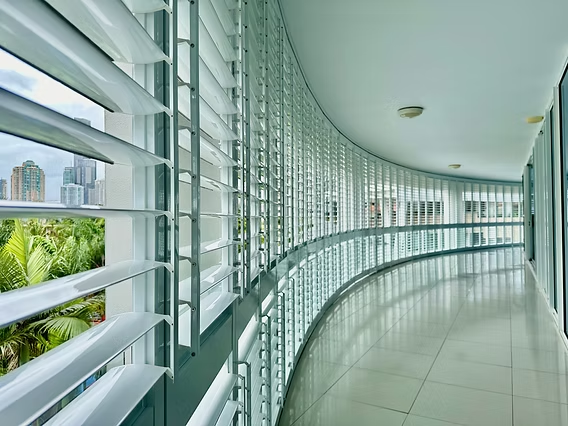
Fixed aluminium louvres are slatted systems installed at a set angle within outdoor structures. Each slat is designed to regulate sunlight entry while permitting air movement. The absence of moving components ensures stable performance with minimal maintenance requirements.
Aluminium construction improves durability in outdoor environments where exposure to moisture and temperature variation is continuous. The fixed positioning also ensures predictable shading patterns, which helps in planning outdoor usability across different times of day and seasons.
Airflow and Ventilation Control
Air movement plays a key role in outdoor comfort. Fixed-angle slats allow air to pass through gaps while reducing heat accumulation under covered areas. This helps maintain a cooler environment in patios, balconies, and sheltered walkways.
Continuous ventilation reduces stagnant air pockets, especially in humid weather conditions. The passive nature of this airflow system avoids energy use while maintaining steady circulation. As a result, outdoor zones remain usable even during warmer periods without mechanical cooling systems.
Weather Protection Across Seasons
Outdoor structures require balanced protection that does not fully block environmental interaction. Fixed aluminium systems provide partial shielding from multiple weather conditions while maintaining openness.
Key benefits include:
- Solar Control: Reduces direct sunlight exposure during peak daytime hours, improving shade consistency
- Rain Moderation: Limits direct rain entry while allowing controlled drainage through angled spacing
- Wind Management: Softens wind intensity without fully enclosing the space, preserving airflow
These functions help maintain usability across seasonal transitions without altering structural design or requiring adjustments.
Thermal Comfort and Energy Balance
Temperature control in outdoor and adjacent indoor spaces improves when solar gain is reduced. Aluminium louvre systems limit direct heat transfer by blocking high-angle sunlight during peak periods. This supports a more stable thermal environment in surrounding areas.
Integration with insulated pergola roofing enhances overall performance by reducing heat absorption from overhead surfaces. Combined use of shading and insulation improves comfort levels in semi-open living spaces, particularly during extended warm periods. This balance reduces dependence on artificial cooling in nearby interiors.
Design Integration in Modern Architecture
Outdoor comfort systems must align with architectural design without disrupting visual balance. Fixed aluminium louvres support clean, linear aesthetics that fit modern residential and commercial layouts.
These systems integrate well with glass façades, steel frames, and open garden structures. The minimal design approach allows them to provide function without visually overpowering surrounding elements. This makes them suitable for contemporary outdoor planning where simplicity and performance are both important.
Seasonal Adaptability in Real Use Conditions
Outdoor comfort depends on how well a structure responds to seasonal change rather than remaining fixed in one condition. Fixed aluminium systems perform consistently across weather cycles due to their passive design.
During summer, shading reduces glare and overheating. In monsoon conditions, angled surfaces reduce direct water entry. In cooler months, partial sunlight penetration helps maintain usable warmth without creating excessive exposure. This steady response across seasons ensures reliable outdoor usability year-round.
Maintenance and Long-Term Performance
Low maintenance is an important factor in outdoor installations. Aluminium does not rust easily and retains structural stability under continuous environmental exposure. This reduces the need for frequent repair or replacement.
Fixed systems also eliminate mechanical wear since no moving parts are involved. Cleaning requirements remain simple, usually limited to occasional washing to remove dust or debris. This supports long-term performance without operational complexity.
Applications in Outdoor Living Spaces
Fixed aluminium systems are commonly used in residential terraces, commercial courtyards, and garden seating areas. Their linear structure blends with modern architectural styles while maintaining functional performance.
These installations support the creation of usable outdoor zones that remain comfortable across changing weather conditions. Fixed aluminium louvres also assist in defining shaded zones without enclosing the space fully, which preserves openness while improving environmental control.
Outdoor dining areas, relaxation zones, and transition spaces between indoor and outdoor environments benefit from this system due to its stable shading and airflow regulation characteristics.
Conclusion
Fixed aluminium louvre systems provide a consistent method for improving outdoor comfort across varying seasonal conditions. Controlled airflow, reduced heat gain, and partial weather protection contribute to more usable outdoor environments throughout the year. Structural simplicity and material durability ensure long-term performance in both residential and commercial applications.