Candles break. Ask anyone who’s shipped a couple of hundred of them there’s always at least one story floating around about a cracked wax edge, or worse, a glass vessel that arrived in three pieces instead of one. This isn’t a category where packaging is just decoration sitting on top of the product. It’s doing actual work, holding things together, and it shapes how the whole brand comes across before the customer even lights the wick.
Working with a handful of candle makers over the last couple of years, I kept noticing the same thing. Brands charging real money for their candles seldom cheap out on the box. But they don’t go overboard either. There’s a middle ground they seem to find, almost instinctively, and once you start looking for it, you see it everywhere.
Wax Is More Fragile Than People Assume
A lit candle looks solid enough. Sitting unlit in the back of a delivery van, though, it’s a different story wax chips at the edges, softens if it gets warm, cracks if it drops even a few inches onto a hard surface. Glass vessels come with their own set of problems on top of that. So before any design decisions happen, the box has one job first: keep the thing still, absorb shock, stop temperature swings from turning a perfectly poured candle into something lumpy and sad-looking.
That’s basically why premium candle brands lean toward rigid or heavy corrugated construction instead of thin folding cartons. It’s not just for the look, though it does look nicer. The thicker board actually absorbs more impact in transit, and that matters way more than most people realize usually right up until they’re staring at a pile of damaged returns.
At This Price, Inserts Aren’t Really Optional
Picture a candle selling for fifty, sixty, eighty bucks. Customer opens the box and the thing’s just sliding around loose inside. Even if it arrived undamaged, that moment alone makes them feel like they overpaid. A snug insert die-cut cardboard, molded pulp, whatever fits the shape solves two problems at once. Keeps the candle from moving, and also frames it, so it looks presented rather than just dropped in there.
Foam shows up sometimes, mostly for the fancier multi-piece gift sets. But most candle brands are honestly better off with cardboard or pulp. Cheaper, photographs more naturally, and lines up better with the eco-conscious image a lot of these brands are going for anyway.
The Exterior Has to Earn the Word Premium
This is where things get subjective, but a few patterns hold up across the brands that get it right.
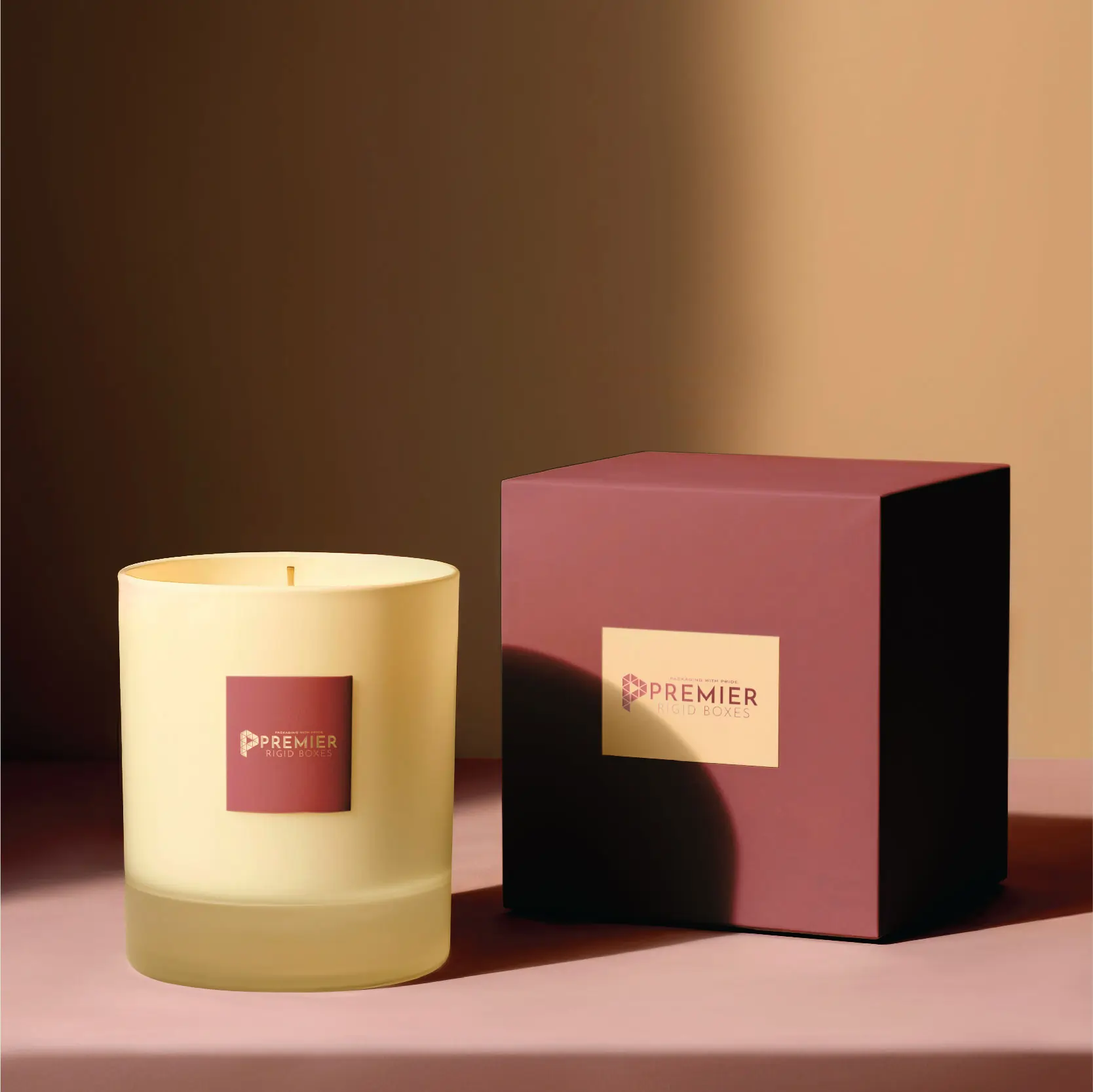
Matte black, deep charcoal, and muted earth tones dominate the high-end candle space right now, and there’s a reason they photograph beautifully under the warm, soft lighting most candle brands use for their marketing. Bright white boxes can look clinical, almost pharmaceutical, which is rarely the vibe a scented candle brand is going for.
Foil stamping on a logo, done sparingly, adds a metallic flash without overwhelming the box. Gold works on darker board, silver or copper on lighter tones. Embossing does something similar but relies on texture instead of shine, which some brands prefer because it photographs well even in flat lighting.
A magnetic closure lid is almost a signature move at this point for higher-end candle packaging. It’s a small mechanical detail- that soft click when the lid shuts, but it does a lot of work in making the unboxing feel deliberate rather than just functional.
Sustainability Isn’t Really Optional Anymore
This one splits opinion. A die-cut window lets the customer see the candle, the wax color, maybe visible botanicals or a decorative wick, before opening the box. It builds trust and can genuinely help conversion for online sales where the buyer can’t touch the product first.
The tradeoff is protection. A window is a weak point structurally, and it can let light hit the wax during storage, which sometimes causes slight discoloration over time depending on the wax blend and any added color. For candles going into long-term retail display, a solid box usually wins out. For direct-to-consumer brands shipping quickly, a small window can work fine.
Sizing and Fit Actually Affect Cost
Oversized candle boxes cost more to ship and, worse, they look like the product is smaller than it actually is once it’s sitting inside all that extra space. Getting accurate dimensions before finalizing box specs matters more here than in a lot of other product categories, partly because candle jars and vessels vary so much in shape between brands, even within the same brand’s product line sometimes.
For brands ordering candle boxes wholesale, this is also where the real cost savings show up. Dialing in exact dimensions before a bulk print run avoids paying for wasted board and avoids ending up with a warehouse full of boxes that are slightly, annoyingly, the wrong size for a new product launch six months later.
Small Details That Signal Quality
A ribbon pull tab inside the base, a printed care card tucked under the candle, a wax seal on the outer flap none of these are necessary, but they add up. Customers spending real money on a candle are often buying the ritual around it as much as the scent itself, and packaging that reflects that intention gets noticed, remembered, and mentioned in reviews.
Final Thoughts
Elegant candle packaging isn’t really about piling on extras. It’s protecting something genuinely fragile while still matching whatever tone the brand’s going for minimalist, moody, botanical, whatever. Nail the structural side first. Add finishing touches carefully, one at a time, not all at once. Do that and the box ends up doing exactly what it’s supposed to making the candle feel like it was worth what somebody paid for it.