Most damaged jewelry orders don’t come from a careless courier. They come from a box that was a few millimeters too tall or too short.
Here’s how it usually goes. Someone measures a ring, picks a box that fits it nicely, and moves on. Nobody checks how much air sits above the ring. Then it spends a few days bouncing around in a van, and the customer opens it to find the ring flipped over or a stone with a fresh chip.
Length and width get all the attention, and depth gets none.
What depth actually controls
Length and width only answer one question: Does the piece fit? Depth answers a harder one. What happens when the parcel is dropped, tilted, or has a heavy carton dumped on top of it? Most transit damage happens in those moments, and a box can get both of the first two measurements right and still fail.
Not every piece suffers equally. A small stud earring doesn’t care much. A cocktail ring with a tall setting carries a great deal.
Low-profile pieces: don’t give them room to play
Plain bands, flat pendants, and basic studs sit close to the surface. Putting them in a tall box gains you nothing, and it costs you control. With extra headroom, a ring that went in standing up can end up flat on its side by the time it arrives. [Add a real example from your own shipping experience here.]
A shallow box keeps the insert close and holds the piece firmly. Less wiggle means fewer scratches and fewer bent prongs.
Tall pieces: leave breathing space
Think of statement rings, chunky pendants, and anything with clustered stones or a high claw setting. If the lid rests on one of these, every squeeze or knock on the outside goes straight through to the stones. Bent settings usually start this way.
So measure the piece at its highest point rather than around its base, then add a small gap above it. Small is the important word. Leave a big gap, and you’ve handed the piece space to slide about again.
Necklaces break the rules
A necklace is the odd one out. Pack a fine chain under pressure, and it can crease. Drop it loose into a deep box, and it bunches into a knot by the time it’s opened, which is one of the quickest ways to annoy a customer.
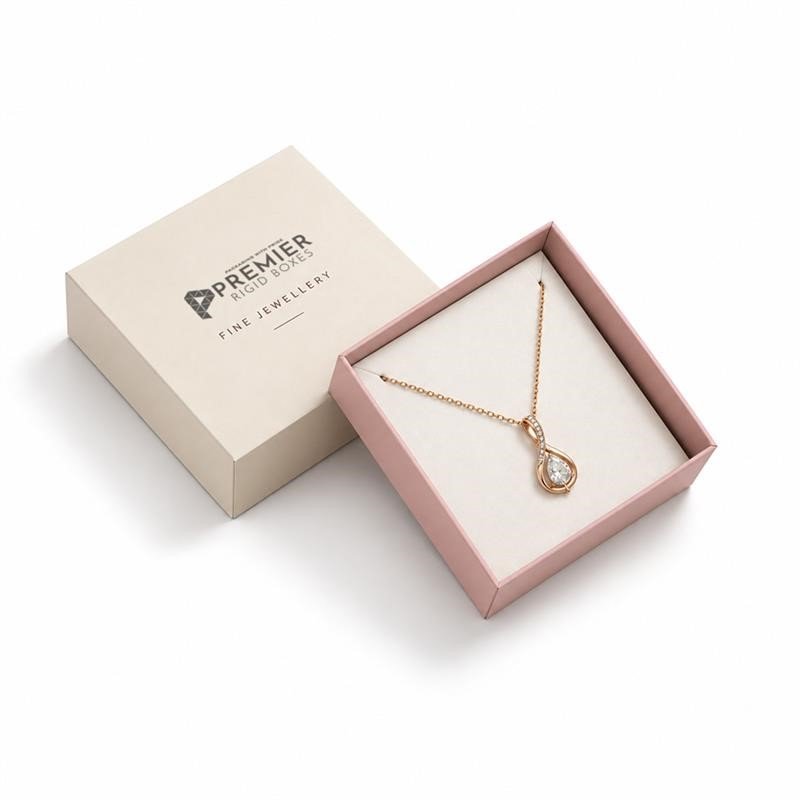
Depth can’t solve this, so stop asking it to. A custom necklace box with a sleeve works better. The chain is fixed to a card or held under the sleeve, so it stays laid out no matter how deep the box is.
Quick reference
- Rings: shallow, snug, very little air above
- Stud earrings: shallow, same idea as rings
- Dangle earrings: a little deeper, so the drop hangs freely and isn’t crushed
- Flat pendants: shallow to medium, depending on chain length
- Statement or raised pieces: deeper, measured from the highest point
- Necklaces: forget depth, focus on a sleeve or card that holds the chain still
Too shallow, too deep
Go too shallow and tall pieces end up pressed against the lid. Stones loosen, settings warp, and now and then a stone falls out altogether. Even flat White Cardboard Jewelry Boxes can get squeezed if they flex under load.
Go too deep and everything gets loose. Pieces flip, rub together, bend prongs, and tie chains in knots.
You can’t spot either problem by looking at a closed box. The dimensions seem right, and you only find out when a customer emails you a photo.
FAQ
Is depth as important as width?
Usually, yes. Depth decides how far a piece can travel vertically, and that movement causes plenty of scratches and chips.
Why are necklaces handled differently?
Rings and studs stay put. Chains don’t, so they need a sleeve or wrap to stop them moving.
Can a box be too deep?
Yes. Extra space lets pieces shift and knock around, which can be worse than a slightly tight fit.
How do I measure raised jewelry?
Find the tallest point, then add a small buffer so the lid never touches it.
Can one depth suit an entire collection?
Rarely. A single depth tends to crush some items and let others rattle.
Wrapping up
Nobody thinks about box depth until a customer sends a photo of a bent setting or a tangled chain. Look at how each piece sits and moves, then choose a depth that fits it. Planning this takes longer than reusing a single box for everything, but it reduces returns.