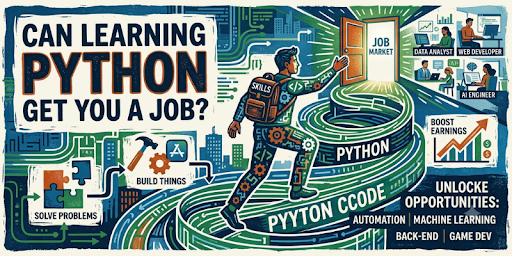
If you’re aiming to become a tech professional, learning a programming languages can seem like a daunting challenge. One reason for this is that Python’s syntax is relatively straight forward to understand, and it is also used in many aspects of the industry. But does learning Python make you job ready? Yes, it can, but being knowledgeable of Python is not the only requirement for getting to a job.
Why is Python Helpful for Career?
Python is not just for a specific purpose. It’s used for various things by developers, data analytics, testers, automation engineers, and machine learning professionals. The syntax is also very simple making the language easier to learn and for a beginner to concentrate on concepts and problem solving than on the syntax.
These are some of the popular applications of Python Programming:
- The development of the web and backend.
- Analyse and visualize data.
- Data analysis and visualization
- Test automation
- Task and task workflow automation
- Data engineering
- Create and modify scripts and applications.
Beginners trying to learn all Python related technologies at once, can find a direction to pursue, understanding python work and what jobs use python.
You can build a career with Python in various ways.There are several career paths to follow with Python. Python is one of the helpful features is that it is flexible. A web developer might try to learn about frameworks like Django or Flask, whereas another learner could learn how to use Python data analysis and visualization libraries.
Python is also highly beneficial for automating tasks. Scripts can be used to automate repetitive task, such as file operations, data processing, testing, or routine operations. This may be beneficial in some technical processes since it can save time and decrease the manual effort.
If someone is just starting to learn to program in Chennai, a structured learning path might make things easier. A Python Course in Chennai can be a part of it, especially if the class is focused on the fundamentals of programming and application using practical examples.
Familiarity with the Python syntax might not be sufficient for a technical job application. Employers may also require knowledge of databases, development tools, version control, or other technologies, depending on the role.
A learner can progress in the acquisition of the following skills:
- Variables, Functions, Loops and Data structures
- Object-oriented programming
- SQL and databases
- Use of version control and Git.Version control and the use of Git.
- APIs and JSON
- Debugging and testing
- The following is a list of basic software development practices.
Projects are particularly valuable as they show how programming knowledge can be used in actual application situations. You will learn more about problem-solving and debugging from a small project than just by reading out the concepts of programming.
Avoid Memorizing, Practice is More Important
It’s simple for weeks and not write much code. The better way to do it is to learn while practicing. Focus on basic programs and build up confidence and skill level as you go.
For instance, you could construct:
- A tool to keep track of personal expenses
- A weather application
- A script to manage files on a server.File management script.
- A simple Web Application
- A project for visualizing data
- The following represents a simple automation tool.
Hyd App Developers who are working on enhancing their programming knowledge can refer Python Training in Hyderabad resources and keep on coding with small projects. The key is not just to finish tutorials, but why the code is doing something, and how to make changes to it on your own.
Develop Skills in Relation to a Career Objective
When it comes to the use of Python, knowing what to do with it makes it a lot more useful. For Data analyst and data related jobs, they might require SQL, Statistics, Pandas skills and visualization skills. Interested in software development may require databases, APIs, frameworks, and software development concepts.
This can help to make learning less overwhelming. Don’t attempt to learn all aspects of Python; just stick to the technologies that align with your chosen career.
A Python Course in Mumbai can be pursued along with practising on your own, developing a project and learning other tools that are relevant to your desired job profile in Mumbai.
Create a Portfolio Before Applying
A portfolio can provide you with something to speak about in an interview. You don’t have to have dozens of projects. The concise expression of your solution, coding, data handling, and application development processes, in a few well-developed projects.
Make each project as understandable as possible:
- What is the purpose of the problem?
- What Python ideas did you employ?
- What tools and/or libraries were used?
- What were some of the difficulties you encountered?
- How did you find the solutions in each of them?
It can also be important to be able to explain what you did, sometimes more important than the code you wrote.
In general, Python Course in Delhi can be a part of a more comprehensive course of study, covering Python basics, hands-on projects, and industry-relevant technologies, tailored to individuals seeking to build their technical expertise in the field.
Is Python the Only Programming Language You Need to Get a Job?
A programming language is only part of the equation to launching a technology career in Python; it’s the job hunt that matters. Firms can also consider problem-solving skills, real-world experience, projects, communication skills, and technology-related knowledge for the role.
The bright side is that Python can be used in various domains and thus is an excellent starting point for novice programmers. If the basics are understood, then one can slowly transition into other areas like development, automation, data or artificial intelligence.
The Bottom Line
Knowing how to apply Python is, of course, what matters more to this field, because knowing Python is just the starting point to support a career in technology. Decide on a career path, acquire the tools that go with that career, practice the tools and create projects to show the competencies.
It’s not necessary to learn everything in one single step. Build the basics, continue to acquire skills, and build knowledge as you go towards your desired career path.